
Statistics don’t lie, and when it comes to the oral health of Europe’s population they paint a rather bleak picture. Even among 12-year-olds, an average of 0.5–3.5 teeth are affected by decay, and among 35–44-year-olds the rate of gum disease is considerable.
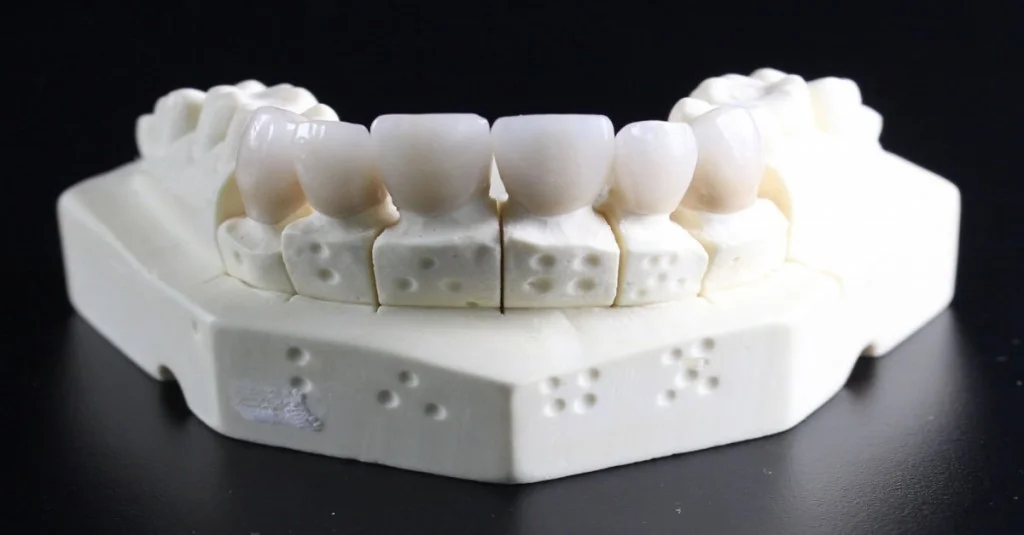
It’s no wonder, then, that without proper treatment teeth are lost – or damaged so badly that only a crown or bridge remains an acceptable solution. And that’s where the dilemma appears: should you choose a porcelain-fused-to-metal crown or a zirconia crown?
Make no compromises – choose the zirconia crown!
If you want a natural smile, you don’t need to think twice: the zirconia crown is the right choice. Not only is it completely lifelike and indistinguishable from natural teeth, it also comes with a whole range of further advantages.
Let’s start with the fact that expectations of dental restorations today are completely different from just 10 years ago. Of course, they have always had two functions: improving aesthetics and restoring chewing function. But today aesthetics carries far more weight, playing a major role in modern life.
Research also shows that well-kept teeth make us appear more trustworthy and can even help in the job market. A beautiful smile signals to others that we have high standards and value grooming and aesthetics. And on aesthetics you certainly don’t need to compromise – restorations like these are sometimes even more beautiful than natural teeth.
Zirconia crowns are indistinguishable from natural teeth
The reason zirconia crowns look so convincingly natural lies in the material’s special properties. The introduction of zirconium oxide was a milestone in dentistry that revolutionised restorations – it outperforms every metal used in dentistry, in every respect.
What makes the zirconia crown so aesthetic is that zirconia – unlike metals – is translucent, so zirconia crowns look just as lifelike as natural teeth, which also let a little light through, most noticeably in the front teeth.
Zirconia crowns are also available in countless shades, so they can be matched perfectly to neighbouring teeth.
Zirconia crowns last a long time
Another great property of zirconia plays a key role in durability. Thanks to its high flexural and tensile strength it is superbly suited to making restorations, and as a very hard material, a long lifespan is assured. We should add that this only holds true with proper oral hygiene – and regular dental check-ups shouldn’t be neglected either.
The importance of longevity hardly needs stressing – it matters greatly how often you have to repeat the costly and often time-consuming process of having a crown or bridge made. Prettau zirconia deserves a mention here: its advantage is that crowns are milled from a single block, so there is no ceramic veneering layer that could ever chip off.
Zirconia crowns are biocompatible – no allergic reactions
We won’t go into why there are so many allergy sufferers today, but studies suggest around one in five adults is allergic to at least one substance – including the metals used in dentistry (nickel, chromium) from which metal-ceramic crowns are made.
Zirconia, by contrast, is completely biocompatible: the body doesn’t reject it and it causes no allergic reactions – so even people with metal allergies can have a zirconia bridge or crown.
5 arguments in favour of zirconia crowns
Here’s a quick summary of the arguments for zirconia crowns and bridges.
1. They are aesthetic and look completely natural.
2. They are robust and stand up to daily wear.
3. With proper oral hygiene, they last a very long time.
4. They can be matched precisely – with no grey discolouration at the gum line.
5. They contain no metal, so they cause no allergic reactions.
Convincing, isn’t it? All that’s left is to book an appointment – and soon you too can smile with confidence!